
Weights and dimensions
Couriers charge on the space a parcel takes up, not just what it weighs. This page explains how ExpressRoad works out your billable weight, gives you a live calculator that mirrors our quote engine, and shows how to pack smart so you never pay for empty air.
Key points
- Every parcel has two weights — actual and volumetric — and you are billed on whichever is higher, never on both.
- Volumetric weight is Length × Width × Height ÷ 5000, with all three measurements in centimetres.
- The higher figure is rounded up to the next whole kilogram, then multiplied by the number of identical parcels.
- The ÷ 5000 divisor applies to all ExpressRoad services — road, cross-border and international alike.
- Couriers re-weigh and re-measure at collection, so declare the finished, packed parcel accurately.
Actual vs volumetric weight
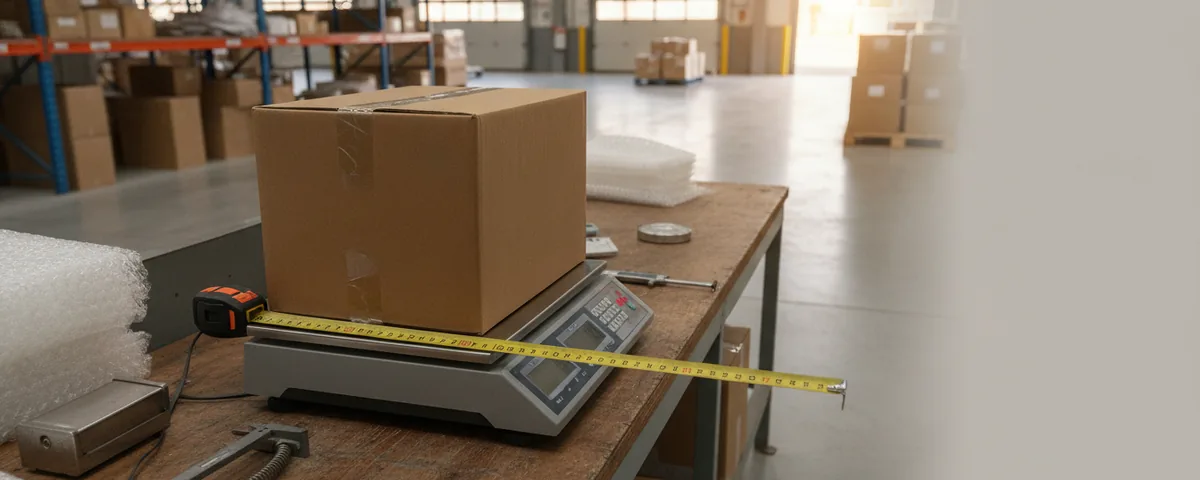
Every shipment has two weights, and you are billed on whichever is higher. Actual weight is what the parcel reads on a scale, in kilograms — simple and familiar, but it ignores size. Volumetric (dimensional) weight is calculated from the parcel's size: a big, light box takes up delivery-vehicle space that could have carried heavier freight, so it is charged for that space.
| Basis | Actual | Volumetric |
|---|---|---|
| What it measures | Mass on the scale, in kilograms | The delivery-vehicle space the parcel occupies, worked out from its size |
| How the figure is produced | Weigh the finished, packed parcel — contents plus box and padding | Length (cm) × Width (cm) × Height (cm) ÷ 5000 |
| Heavy & compact — machine parts, 30 × 20 × 15 cm | 8 kg — billed on actual | 1.8 kg |
| Light & bulky — clothing or gifts, 60 × 40 × 30 cm | 3 kg | 14.4 kg → 15 kg — billed on volumetric |
| When it decides the price | Whenever it is the higher of the two — dense, well-packed freight | Whenever it is the higher of the two — large, light parcels |
| Where it applies | Every ExpressRoad service | Every ExpressRoad service — the ÷ 5000 divisor is identical for road, cross-border and international |
This is a universal courier and freight standard. Twenty kilograms of foam fills far more of a vehicle than twenty kilograms of steel, so pricing on volume as well as mass keeps rates fair for everyone.
The ExpressRoad formula
- We take the higher of actual weight and volumetric weight for each parcel.
- That figure is rounded up to the next whole kilogram, then multiplied by the number of identical parcels.
- The ÷ 5000 divisor applies to all ExpressRoad services — road, cross-border and international alike.
Live billable-weight calculator
Enter your parcel's dimensions and actual weight. This calculator uses exactly the same maths as our quote engine, so the billable weight it shows is the one your quote is built on.
⚡ Billable weight calculator
Measure to the parcel's widest points and enter whole centimetres.
This tool is a guide. Couriers re-weigh and re-measure at collection; if the parcel is larger or heavier than declared, the quote is adjusted to the measured figures.
Worked examples
| Parcel | Dimensions | Actual | Volumetric | Billed on |
|---|---|---|---|---|
| Heavy & compact — machine parts | 30 × 20 × 15 cm | 8 kg | 1.8 kg | 8 kg actual |
| Light & bulky — clothing, gifts | 60 × 40 × 30 cm | 3 kg | 14.4 kg → 15 kg | 15 kg volumetric |
| Slightly bulky — boxed appliance | 73 × 32 × 13 cm | 5.7 kg | 6.07 kg → 7 kg | 7 kg volumetric |
The light-and-bulky parcel is the classic surprise. A 60 × 40 × 30 cm box weighs 3 kg on the scale but bills at 15 kg — five times as much — purely because of its size. If you can pack it smaller without risking the contents, you save on every shipment.
Six ways to keep your billable weight down
1. Right-size the box
Use a carton just big enough for the contents plus 2–3 cm of cushioning per side. Oversized boxes cost money on every trip.
2. Use compressible packing
Bubble wrap and air pillows take less room than polystyrene chips when packed well, and protect just as effectively.
3. Disassemble where safe
Flat-pack furniture and tools that come apart should travel apart. Reassembly is minor; volumetric overage recurs every shipment.
4. Roll, don't fold
Soft goods like clothing and fabric compress better rolled (and vacuum-bagged) than folded flat into a wider carton.
5. Consolidate parcels
Several small items in one well-filled mid-size box usually beat two half-empty cartons on total billable weight.
6. Check before you seal
Run the dimensions through the calculator above first. If volumetric is far above actual, reach for a smaller box.
Measuring & declaring accurately
Measure the packed parcel, not the contents
Your billable weight is only as accurate as the figures you give us. Measure the sealed carton at its widest, longest and tallest points, and weigh it fully packed — contents, box and padding together. Those are the same two readings the depot takes at collection, so getting them right up front is what keeps the quoted price and the final price the same.
- Measure to the parcel's widest, longest and tallest points, including any bulge in the packaging.
- Weigh the finished, packed parcel — contents plus box and padding.
- Declare each parcel accurately at booking. Under-declared size or weight is corrected at collection and the price adjusted, which can also delay dispatch.
- For multiple identical parcels, enter the per-parcel figures and the quantity — that is how our quote engine totals the shipment.
Frequently asked questions
Why am I charged more than my parcel weighs?
How is volumetric weight calculated?
Does the divisor change for cross-border or international shipments?
What happens if I get the measurements wrong?
How do I lower the cost of a bulky parcel?
Related pages
Know your weight? Get your price.
Enter your parcel details for an instant, all-in quote — the billable weight above is exactly what your quote is built on.
Get a Quote Contact Us